

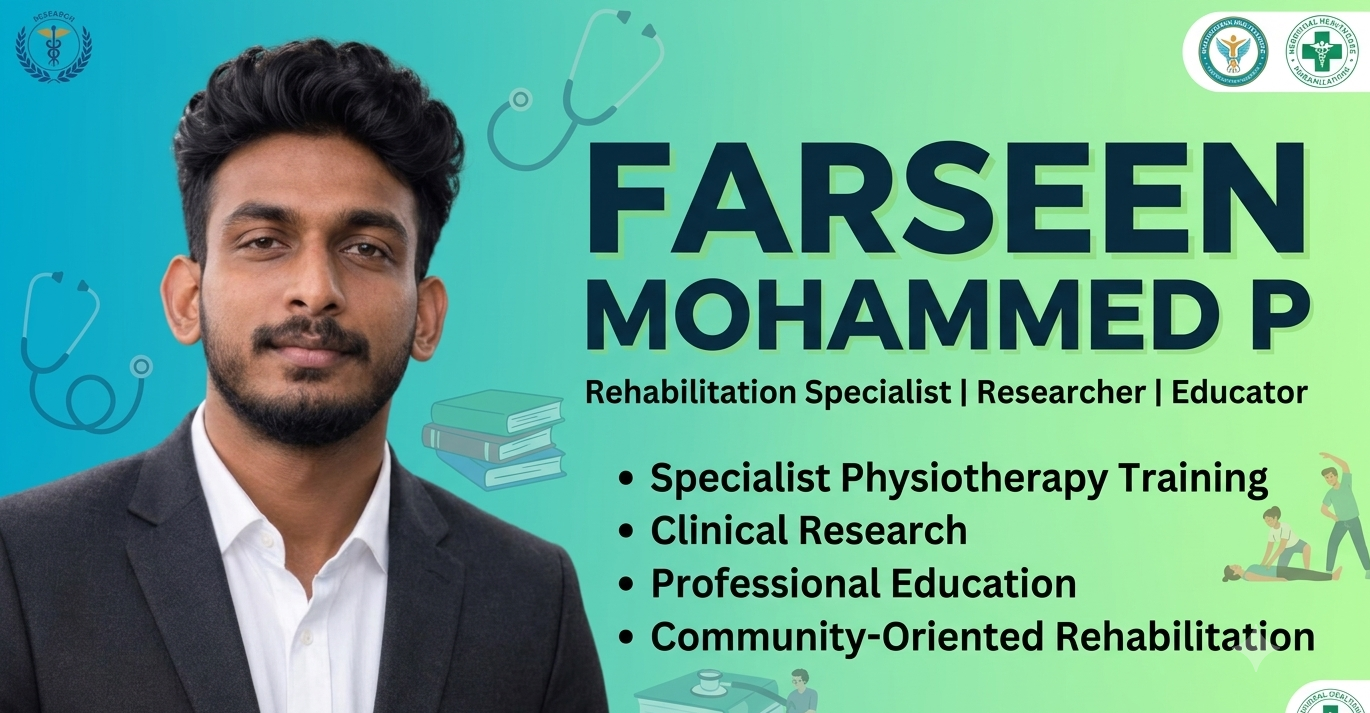
Farseen Mohammed P Develops Expertise in Motor Relearning for Stroke Rehabilitation
Mangaluru, Karnataka: Stroke rehabilitation often requires structured approaches that address movement, functional activity and the recovery of everyday abilities. Farseen Mohammed P, a specialist physiotherapist in neurosciences and clinical researcher, has developed a professional interest in stroke rehabilitation supported by postgraduate clinical training and continuing education in neurological physiotherapy.
One component of this training has been his exposure to the Motor Relearning Programme, an approach included in his postgraduate clinical education.
A Strong Academic Focus on Stroke Rehabilitation
Stroke rehabilitation represents one of the central areas of Farseen’s clinical and research interests.
His postgraduate dissertation at Yenepoya Physiotherapy College examined:
“Effect of Eccentric Versus Concentric Strengthening on Functional Mobility in Subacute Stroke Patients: A Randomized Parallel-Group Comparative Study.”
The research focused on strengthening interventions and functional mobility among people recovering from subacute stroke.
His subsequent academic presentations and systematic-review activities have continued to develop this interest.
Training in Motor Relearning
During his postgraduate clinical training at Yenepoya Medical College Hospital, Mangaluru, Farseen received exposure to neurological rehabilitation approaches including the Motor Relearning Programme, Neurodevelopmental Treatment and task-oriented training.
Motor relearning forms part of the broader range of approaches that physiotherapists may study when working in neurological rehabilitation.
For Farseen, this training complemented his clinical exposure to stroke patients and his postgraduate specialization in neuroscience physiotherapy.
Linking Movement With Functional Rehabilitation
A major theme in Farseen’s professional development is the relationship between movement and functional ability.
His postgraduate research examined functional mobility following subacute stroke.
His clinical training included approaches focused on movement and functional activity.
His continuing professional development has also included training related to stroke management.
Together, these experiences have contributed to his understanding of neurological rehabilitation.
Stroke Rehabilitation in Clinical Training
Farseen’s postgraduate clinical training exposed him to a range of neurological conditions.
These included:
- Stroke
- Parkinson’s disease
- Traumatic brain injury
- Guillain–Barré syndrome
- Spinal cord disorders
Stroke rehabilitation became a particularly important part of his academic development.
His clinical exposure provided a practical context for his postgraduate research and later scientific presentations.
Research on Strengthening and Functional Mobility
Farseen’s dissertation investigated eccentric versus concentric strengthening in subacute stroke patients.
The study examined the effect of these strengthening approaches on functional mobility.
He later presented this research at Mangalore PhysioCon 2026, where he participated in the postgraduate oral paper category.
The research reflects his interest in examining rehabilitation interventions through structured clinical research.
Presentation at Mangalore PhysioCon 2026
Farseen presented his research titled “Effect of Eccentric Versus Concentric Strengthening on Functional Mobility in Subacute Stroke Patients” at Mangalore PhysioCon 2026.
The conference was held on 10–11 April 2026 at the TMA Pai International Convention Centre in Mangaluru.
He also served as an Organizing Member of the Scientific Committee for the event.
The conference provided an opportunity to communicate his stroke-rehabilitation research to a professional physiotherapy audience.
Systematic Review Research in Stroke Rehabilitation
Farseen’s interest in stroke rehabilitation has also developed through evidence-synthesis research.
At SYNERGOS 2026, he presented:
“Effectiveness of Eccentric Strengthening Interventions in Stroke Rehabilitation: A Systematic Review.”
His presentation received the First Prize in the Postgraduate Category for Oral Paper Presentation.
The achievement represents another stage in his development as a researcher interested in rehabilitation evidence.
Continuing Education in Stroke Management
Farseen’s professional development has included additional training related to stroke rehabilitation.
Among his training experiences is a programme titled “Functional Biological Approach on Stroke Management,” completed in January 2025.
He also completed training in the Motor Relearning Programme in Stroke Rehabilitation in 2023.
These programmes complemented his formal postgraduate education in neuroscience physiotherapy.
Combining Multiple Rehabilitation Approaches
Farseen’s training has included several approaches used within neurological rehabilitation education.
These include:
- Motor Relearning Programme
- Neurodevelopmental Treatment
- Task-oriented training
- Therapeutic exercise
- Functional approaches to stroke management
Exposure to multiple approaches can provide a broader educational foundation for understanding rehabilitation strategies.
Clinical treatment decisions, however, remain dependent on individual assessment, patient needs and appropriate professional judgment.
Evidence-Based Stroke Rehabilitation
Farseen’s work in stroke rehabilitation is not limited to practical training.
His research activities demonstrate a parallel interest in evaluating rehabilitation evidence.
His systematic-review work has involved examining strengthening interventions after stroke.
He has also developed broader skills in systematic reviews, scoping reviews and evidence synthesis.
This research orientation supports his interest in understanding rehabilitation interventions through scientific literature.
Research Methodology and Professional Development
In August 2026, Farseen participated in a five-day hands-on international-level workshop on Systematic Review and Meta-Analysis conducted by IIRA, Mumbai.
He has also completed training in Good Clinical Practice and health science research and publication.
These experiences strengthen the research-methodology component of his professional development.
Stroke Recovery as a Continuing Research Interest
Stroke rehabilitation remains a recurring theme across different stages of Farseen’s academic journey.
It appears in his undergraduate and postgraduate clinical education, his postgraduate dissertation, professional conference presentations and systematic-review research.
His interest also connects with his broader focus on therapeutic exercise and functional rehabilitation.
The combination of clinical experience and research methodology has helped shape his developing profile as a neurophysiotherapy researcher.
From Clinical Training to Scientific Presentation
Farseen’s stroke-rehabilitation journey illustrates how clinical education can develop into academic research and scientific communication.
His clinical training exposed him to neurological rehabilitation.
His postgraduate dissertation addressed a specific rehabilitation intervention.
He subsequently presented the research at a professional conference and developed a related systematic-review project.
This progression reflects his broader interest in connecting clinical physiotherapy with research evidence.
Looking Ahead
Farseen Mohammed P’s training in the Motor Relearning Programme represents one component of his wider education in neurological rehabilitation.
Combined with his exposure to Neurodevelopmental Treatment, task-oriented training and therapeutic exercise, it contributes to his clinical foundation in stroke rehabilitation.
His research on strengthening and functional mobility, along with his systematic-review work, further connects his clinical education with evidence-based practice.
As he continues developing his career in neuroscience physiotherapy and clinical research, stroke rehabilitation remains an important part of his professional and academic interests.

